Local photographer learns portraiture in Paris
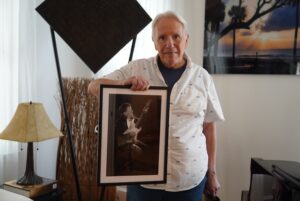
Asa Aarons Smith with one of his portraits, photos by Amber Hewitt
This summer Asa Aarons Smith hopped on a jet and flew to Paris. He was not there for a stroll along the Seine River or a climb up the Eiffel Tower. His specific purpose was to attend a master class in portraiture at Studio Harcourt, a world renowned photography studio around since the 1930’s. Harcourt makes pictures into Art, with a capital A, and that attracted and intrigued Asa.
“There was always something going on [in their portraits] that was sort of penetrating.” Asa noted, “You could see the subject’s character coming out, and I thought that’s it. That’s what I want to learn how to do.”
It was Asa’s wife Noreen who bought the class for him after she saw he had spent time researching Studio Harcourt on the web. They traveled to Paris together, and Asa in return gifted her a cooking class.
After the twelve hour session Asa was exhausted and exhilarated. He posted on LinkedIn about the experience and noted that despite his almost forty years’ experience being on television he was humbled and nervous. He wrote that he got what he came for and more,
“I came home with an array of new technical tools and a renewed understanding of why I picked up a camera in the first place.”
And that’s why the story really starts far away from France and decades in the past.
Picture Asa as a kid growing up in the flat suburbs of Northwest Ohio. The nearest big city is Toledo, and that is where Asa eventually got his big break, the one that propelled him to New York and a career of television fame and a darn good living. But before all that there’s trouble.
The kid loses his dad early and has serious conflicts with his stepdad, the new authority figure in the house. He ends up leaving home, living in foster care, and dropping out of high school. He gets his GED and takes a few college communication courses at Cleveland State.
Throughout all this he is developing a real passion for photography. He is naturally curious and perhaps, given his circumstances, it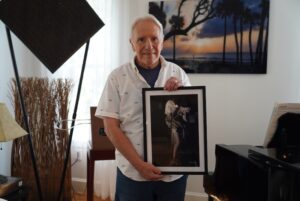 feels right to have a little distance from the world afforded by a camera lens. He embraces his inner observing eye.
The result of his interest is getting a job in a local photo studio, the kind that cranked out those family portraits taken in front of fake backgrounds. The ones that graced innumerable living room walls back in the day, mounted above the shag carpeting.
Asa then started taking photos for a local newspaper. It turns out Asa can also write, and a local TV news director took notice and offered him a job. One day he was acting as a field producer for a crew that was covering an industrial tank explosion (film at 6!) and the big break happened.
Asa says when a second tank exploded the on-camera reporter dropped the microphone and took off running (Asa laughs that he still might be). The camera guy looked at Asa and told him he might as well fill-in. So Asa described what he was seeing and they filed the story. Asa points out that at the time he was two hundred and fifty pounds and had a wild beard. He jokes that it was like “Rasputin doing the news.”
At first, he worried he was going to be in trouble when he got back to the station. Instead, the news director said he liked what he saw and wondered if Asa could get a haircut and buy a tie. Done and done.
The rest plays out like a fairy tale, with the magical breadcrumbs of evidence all over YouTube. He ended up in one of the biggest media markets in the world, doing “Ask Asa” consumer stories for local New York City news programs.
There were thousands of these stories that produced happy conclusions. Asa made justice happen. He cut through red tape, confronted unscrupulous business of all kinds, and sought consumer justice as fervently as a missionary. People were caught in jams involving cloned ATM cards, counterfeit purses, annoying squirrels, highjacked computers, and even a bogus Justin Bieber fan club that got a young woman to send money without giving anything they promised in return. You can now watch these brief and punchy “Ask Asa” pieces for hours on a computer.
The best story is probably helping a couple complete a foreign adoption after lost paperwork threatened to derail it. Sixteen years later Asa was contacted by the young woman whose parents showed her the “Ask Asa” pieces that solved the problem. She told Asa he was her hero.
After this illustrious career of doing consumer news he moved to the Lowcountry a dozen years ago. After a little bit of freelance work for a Savannah station Asa came full circle and once again focused on photography. Paris called and Asa answered.
Upon arrival at Studio Harcourt Asa had a moment of realization.
“I wasn’t prepared for how serious they took portraiture,” Asa said, “I was nervous, you know? What am I going to see here? What’s going on? I just kind of opened myself up to learning.”
Asa reflected in his LinkedIn post that Harcourt treats taking portraits as an interpretive quest. All aspects of light, posture, and expression are considered. The studio uses Fresnel lighting instead of flash, which creates drama, clean shadows, and a moody throwback vibe. Asa wrote that in this esteemed studio, “Every detail exists to reveal character, not just appearance.”
His instructor was Julian, whose English was delivered with a heavy French accent and a serious demeanor. Rose was his model. He learned about turning and tilting shoulders and placing the “larger” eye behind (most people have slight facial asymmetry that makes eyes appear varied sizes). The sum of Julian’s knowledge added up.
“There were just little techniques that seemed so small, like the thing with the eye, or the shoulder,” Asa reflected, “They seem so small, but they make a big difference.”
After a brief side trip to Italy after, Asa returned to the Lowcountry primed for action.
“What I really want to do is not just copy what was there,” Asa remarked, “But I want to bring the influence and the spirit of the studio there [and apply it] to the interesting people in Beaufort.”
Asa is grateful for all he was able to absorb and learn in Paris. Now he wants to combine the new techniques and his natural curiosity about people to launch his next pursuit, a book of portraits of those interesting Lowcountry individuals.
Whatever it is, he says he won’t hesitate but will go for it, like he did when he traveled four thousand miles to the City of Lights.
“You can hold back on adventures in life and things that you want to do,” Asa cautions, “But in the end, you’ll regret it.”
And after this declaration delivered by a man with clear eyes and an intense gaze, there was really nothing else to ask Asa.