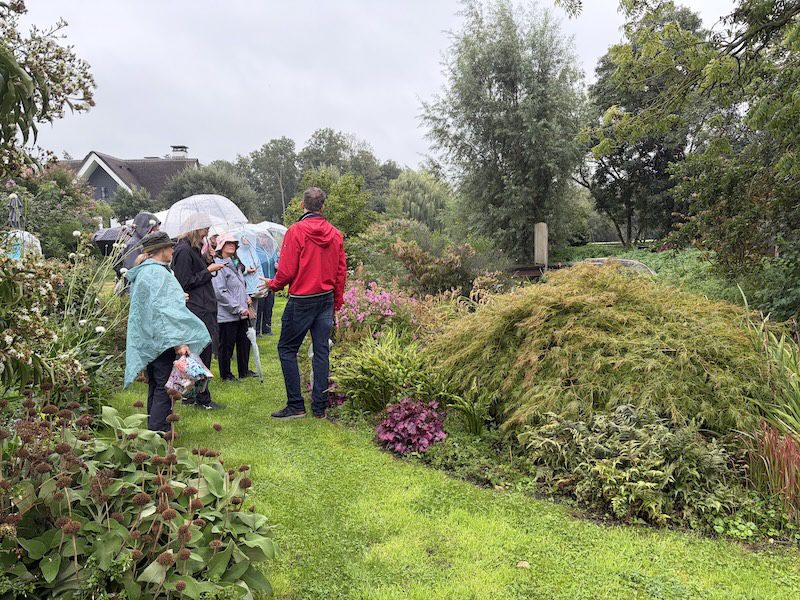
 At five feet eight inches, I have always thought of myself as tall. While standing in the lobby of the Rotterdam Hilton, I felt like a diminutive garden gnome although without the red hat. The Dutch are uniquely tall people. And after nine days visiting gardens and villages all over the Netherlands, they are also uniquely amazing gardeners. I was fortunate to be able to join a garden design tour led by award winning English garden designer, Annie Guilfoyle, and sponsored by Fine Gardening Magazine. What I saw in the gardens we visited has my mind spinning with new ideas for my own garden as well as a community garden that I maintain.
I think that many people are aware of the amount of plant material that comes from the Netherlands as well as some of our vegetables and herbs. The Dutch have always been cultivators of the land even though much of it is reclaimed from the sea and below sea level. The saying is that “God created the world, but the Dutch created the Netherlands.” This saying reflects thousands of years of the people both fighting and yet embracing the water around them. The reclaimed lands, called polders, are rich with agricultural activity and hundreds of plant nurseries.
What did I learn from visiting Dutch gardens, both private and public, as well as plant nurseries? I could almost write a book! One of the first things I noticed is that the Dutch bring the outside inside. Their gardens are extensions of their living space and flow from the house. Every private garden that I visited had a patio or living area directly outside the house and visible from the inside through large windows and sliding glass doors. You step immediately into a verdant area surrounded by plants. Why is that possible? Dutch houses do not have cellars or basements due to their watery world of canals that the houses tend to be built along. In the Lowcountry our houses tend to be raised up and in the north houses have basements that elevate the house above the garden and lawn. Every house that I have lived in has had steps into the landscape- maybe only a few, but there are still steps to separate the house and garden or lawn.
The Dutch are the pioneers of naturalistic planting, that is a landscape that looks close to nature and not contrived. In naturalistic planting, there are no flower beds with geometric shapes and structured plantings., but rather thickly planted meadows with grasses, small shrubs, and perennials. The “rock star” of this style and recognized master is Piet Oudolf, a Dutch designer who is sought after all over the world. He is well known in the U.S. for designing the High Line in New York City as well as the Lurie Garden in Chicago, just to name a few.
Piet is also a proponent of the New Perennial Movement, an approach to gardening that focuses on perennial plants. For years, perennials were rarely used in gardens. In the 1980’s in Europe, this changed with more gardeners discovering perennials, plants that live more than one season. We were slow to catch on, but now perennials are a mainstay of many gardens. The one disadvantage of perennials is that most of them bloom a certain season (spring, early summer, late summer) and then you are left with a dead looking plant. Plant people like Piet Oudolf believe that the spent plants provide an interest even when they are not blooming. The plant or grass is allowed to stay in the garden and provide winter interest as well as habitat for insects and other wildlife. Piet believes that brown is a color too. In garden after garden, I saw interesting seed heads and dried flowers that were beautiful and not at all ugly or messy looking. The designers whose gardens I visited were clever in having perennials that bloom during each season so that there is always something blooming.
One thing that really struck me was the use of American native plants, particularly plants from our prairies. My favorite South Carolina native, rattlesnake master (Eryngium yuccifolium) was in nearly every garden as well as coneflowers (Echinacea spp.) and goldenrod (Solidago spp.) Sumac (Rhus spp.) was often used as a small tree or shrub and valued for its red fall color. I always tended to regard it as a “junk plant” with no ornamental value. I was wrong. Most American natives are late season bloomers while European natives and exotics tend to bloom April-June.
Grasses are widely used in naturalistic planting. They provide a filler between perennials and give movement when the wind blows. Again, nothing is cut down until the end of February when new shoots appear.
The gardeners that we met do not use pesticides, herbicides, or even fertilizers, yet their plants look extremely healthy. Compost and well draining soil seem to be key. Although I certainly cannot replicate the beauty of Dutch gardens in their distinctive landscape, I did learn designs and techniques that I can take into my own garden. It was a very special and informative trip with very welcoming people.