A look back at the iconic festival and how it put our region on the world film fest map
If you build it, they will come. – Field of Dreams
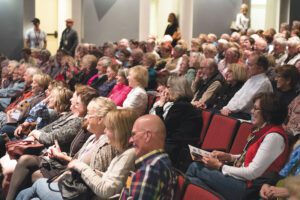
BIFF: Pleasing audiences for 20 years
It seems fitting for a retrospective of our very own Beaufort International Film Festival (BIFF) to open with a line from an iconic film. And the line uttered in a corn field and heard by Ray Kinsella (as played by Kevin Costner) in the 1989 film captures the essence of BIFF, along with the life and careers of its founders, Ron and Rebecca Tucker.
First, a little backdrop to put things in perspective. Originally from Woodruff in South Carolina’s Upcountry, Ron Tucker enlisted in the Marines as a wee one in 1971 and spent 22 years serving his country, including three tours on Parris Island and one tour aboard the USS Iwo Jima during the Persian Gulf War. He retired as a Captain in 1992 at the age of 41and knew that he’d need to find something to do to fill his days.
Amid odds and ends gigs over the next couple of years with the Technical College of the Lowcountry, Ron stumbled upon a book at the public library about the South Carolina Film Commission and was intrigued. He’d loved movies since he was a kid, often spending most of Saturday at the theater, so movies and movie-going were part of his DNA.
Through the book, he signed up for a list of state film contacts, and, with his depth of Beaufort location knowledge and public
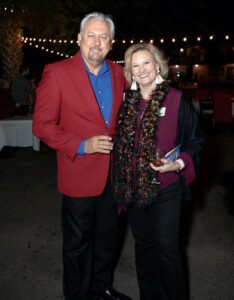
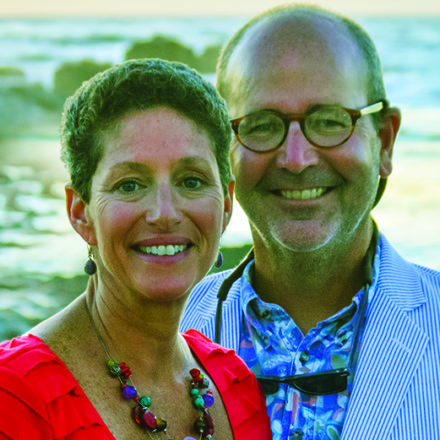
BIFF directors Ron & Rebecca Tucker
relations stints while stationed at Parris Island, he created a film location management business. One of his first paying gigs with this new company was scouting locations for a Talbot’s women’s clothing store catalog.
If you build it, they will come.
Shortly after that, Ron learned that Parris Island was looking for a video production company to help produce graduation videos and, with his familiarity with the Marines and Parris Island specifically, he decided to bid on the project. He quickly created another company called Sandbar Productions. The problem was that he didn’t really know how to produce videos, nor did he even own any cameras. But he knew how to write a script, and he figured he could muddle his way through creating the necessary 10- to 15-minute demo.
He put up a bulletin board notice at SCAD looking for a couple of camera operators. Two students reached out, but they didn’t have
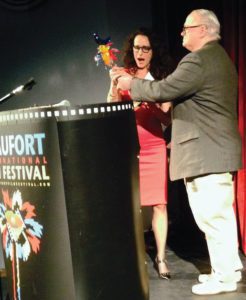
Andie MacDowell and Pat Conroy at BIFF 2015
any cameras. That wasn’t going to stop Ron, however, so he rented two cameras, tapes, batteries, and more from a Charleston production company (all of which arrived in Beaufort on a Greyhound bus), along with hiring a voice to narrate.
If you build it, they will come.
After much effort and money, Ron produced his demo and was given significant encouragement that the job was his. However, in typical military plot twist fashion in the 11th hour, he learned that they had decided to go in a different direction.
In a stroke of serendipity, Ron got a call shortly thereafter from Trident Productions, the video production company he’d used in Charleston to rent the cameras. It seems that they too had bid on the Parris Island contract and were also rebuffed. The production company asked Ron what he was going to do next and he said that he was going to take the footage and create a documentary called, The Making of a Marine. Trident Productions said, “Why don’t you come up here and show us your footage, and we’ll show you ours.”
He watched their video and, although they had all the video production bells and whistles, Ron felt that their production needed more action. Ron thought, why not combine their technical know-how with his ability to write a script and produce the documentary together. This is exactly what they did, and they ultimately produced the first commercially available documentary on Marine Corps recruit training.
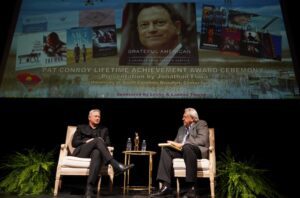
Gary Sinise & Ron Tucker at BIFF 2024
However, this was simply the coming attractions. The business grew, and Sandbar Productions merged with Trident Productions to form a joint venture company called Good to Go Video (GTGV). Together they produced ten more documentaries about Marine recruit training and the famed ceremonial units of the Marine Corps. By 1999, GTGV’s reputation was firmly established, and the opportunity came up for rebidding on the Parris Island contract. This time the bid was accepted and GTGV went on to produce the Graduation Ceremony program for the next 14 years. During that time, they produced over 600 graduation programs with an estimated 250,000 new Marines marching in front of their cameras.
If you build it, they will come.
Joining the GTGV team early on, Rebecca Tucker was the Vice-President of Sales and Marketing, putting her skills and her public

Blythe Danner at BIFF 2010
relations degree from East Tennessee State University to good use. She became a familiar presence at the Parris Island Visitor’s Center each graduation week, interacting with the families of the new Marines, some of whom affectionately referred to her as the Parris Island Ambassador.
Meanwhile, as the Tuckers were deeply rooted in the producing of these Marine Corps programs, Ron continued to explore the location management industry and make connections within the South Carolina Film Commission in Columbia. Several high-profile films had already filmed in Beaufort, including, most notably, the adaptation of Pat Conroy’s, The Great Santini (1978), The Big Chill (1983), Conroy’s The Prince of Tides (1991), and Forrest Gump (1994), but the industry seemed to be waning due to other states and countries offering bigger incentives.
Around this same time, Ron pitched the city to create a Beaufort Film Commission to help bolster Beaufort’s burgeoning film industry. City officials liked the idea but felt that the South Carolina Film Commission was already doing a good job getting films to the state.
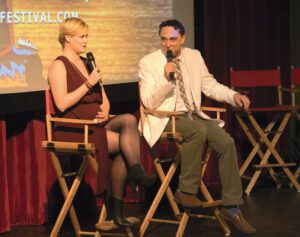
Abigail Hawk & Wally Marzano-Lesnevich at BIFF 2017
Five years later and without another Beaufort production, Ron went to the Chamber of Commerce and re-pitched the idea of a Beaufort Film Commission. They bit and established a spot on the Executive Board of the Chamber for film and named Ron as Chairman of the 16-member commission. They became members of the Association of Film Commissioners International (AFCI), with Ron attending an AFCI training session in Las Vegas.
It was at this fruitful training session that Ron overheard someone talking about putting on a film festival to help promote their area for film production. And Ron thought, “We could do that!”
Upon his return to Beaufort, Ron pitched the Chamber on the film festival concept and, after much discussion and back-and-forth, was given approval to pursue a festival for 2007. It was with the caveat that it would have to be part of an existing line-item weekend called Beaufort Kaleidoscope, along with a Great Chefs of the South event and the Beaufort Artwalk. Without any background or knowledge on the topic (and very little money), Ron and Rebecca rolled up their sleeves to figure out how to put on a film festival.
They secured the empty three-screen movie theater on Lady’s Island, complete with 35mm projectors, for free, courtesy of owner

Filmmakers reception at Anchorage 1770
Paul Trask. They did their homework on how film festivals were put together. They found Withoutabox, a website that provided filmmakers with a platform to find film festivals. They researched how other film festivals were coordinated. And they put out a call for submissions. Miraculously, they received 150 entries in that first year for six film categories: Feature; Student; Shorts; Animation; Screenplay; and Documentary. And BIFF was born.
If you build it, they will come.
Although they had a great venue and pulled together an impressive selection of judges, that premiere two-night event had its challenges. Who knew that different filmmakers used different video formats? Since Ron and Rebecca didn’t, they didn’t give the filmmakers the parameters on how to submit their entries, resulting in a half-dozen formats (and the requisite rental of a half-dozen different projectors).
Who knew that they shouldn’t start airing films at 7:30am? Who knew that you shouldn’t kick off a film festival with a film about a serial killer? And who would have thought of providing food and water for the people that you invited to watch films all day, or to allow the filmmakers time to talk about their films?

Screenwriters Workshop, BIFF 2017
Naturally, there were some learning curves. But the takeaways from year one of BIFF was that this was a way to expose and highlight Beaufort in the minds of up-and-coming filmmakers; it had the bones for a strong tourism draw; and it could become a significant economic driver through venue rentals, sets, props, hotels, restaurants, and more. By anyone’s calculations, BIFF had legs.
So, the cycle continued. “We live and breathe BIFF all year long,” says Ron. Once the festival is over, they take a (very short) hiatus and then start planning for the next one within a month. Calls for entries typically go out in March and film submissions start arriving the next day. The Tuckers spend much of their days watching films from July to November, jotting notes on a spreadsheet as they narrow down the field.
The long list is then sent to half of the jurors, all of whom have some background in film, to be pared down further based on subject quality, acting, technical achievement, festival fit, time, impact, and more. That list is then sent to another set of jurors to be whittled down even further on a sophisticated point-based system. That list is then sent back to Ron and Rebecca to create the short list based on the ranked scores, comments from the jurors, and timing block requirements.
As the years have moved on, Ron and Rebecca have tweaked the event by creating new film categories; going from a two-day event
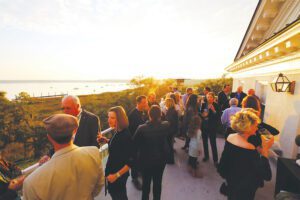
More filmmakers at Anchorage 1770
with an opening night celebration to a six-day event, with a highly coveted opening night soiree and an expanded awards ceremony; showing twice as many films; and expanding the awards to include best film in each category, actor, actress, director, ensemble, Audience Choice; Santini Patriot Spirit Award, Duty & Honor Award, Pat Conroy Lifetime Achievement Award, Jeff Evans Screenplay Award, and more.
Now, as BIFF is geared up to celebrate their 20th anniversary of bringing a touch of Hollywood to Beaufort, the ‘festival that could’ has made its mark in the world of film festivals. It is consistently rated as one of the top 100 film festivals in the world, which is saying a lot when you consider there are something like 14,000 film festivals.
“Film festivals provide a variety of opportunities to filmmakers, particularly independent filmmakers, says Paul Serwitz, Head of Distribution for Roadside Attractions, a prominent independent film distribution company known for acquiring and releasing critically acclaimed indie films that major studios tend to disregard.
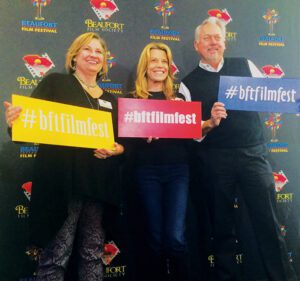
The Tuckers with Vanna White, BIFF 2016
“They serve as a valuable tool to find distribution, they offer a platform for filmmakers to have their work seen by the public as many films never find distribution, and they are vehicles for emerging filmmakers looking for exposure.”
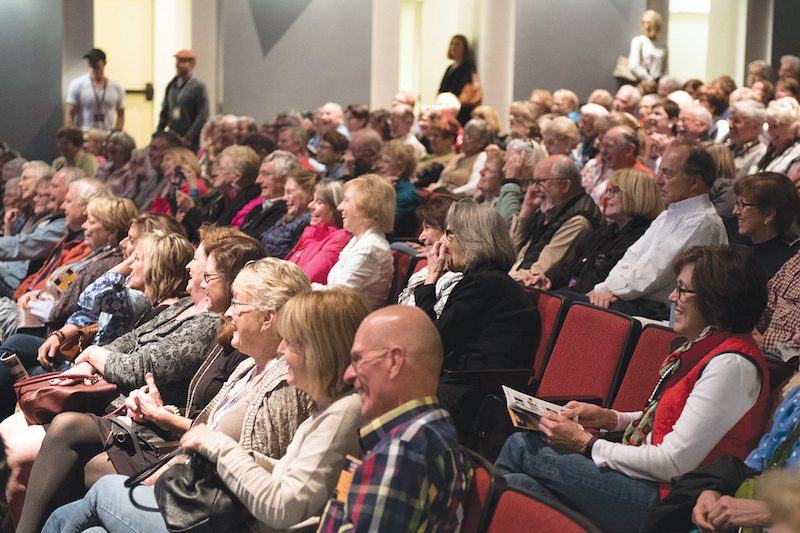
BIFF also draws thousands of filmmakers, cinematographers, screenwriters, lighting, sound, and other industry professionals — the majority of whom rave about the intimacy of the festival; the hospitality of the organizers and the community at-large; the interaction and participation of the audience; the networking opportunities before and after the showings at local downtown places like Hemingway’s, Old Bull Tavern, and Saltus; and the fact that all of the events are under one roof at USCB’s Center for the Arts.
According to LA-based filmmaker Yelena Krivosheyeva, who attended BIFF in 2024, “The screenings were nearly sold out every day, and the audience was so receptive and engaged. Some of the best Q&A I’ve ever heard. The whole town comes together for this festival.”
Actress/producer Jennifer Baker concurs, saying, “The unparalleled southern hospitality and the consistently incredible films
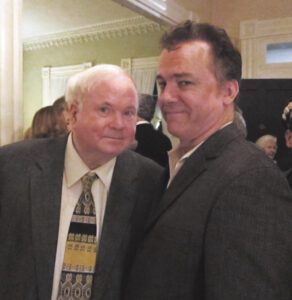
Pat Conroy & Michael O’Keefe, BIFF 2010
means that BIFF has cultivated an artistic community where networking feels natural because it’s creatives sharing their passions.”
Not only do the rave reviews keep BIFF on the tip of filmmakers and attendees tongues, but the numbers speak for themselves. In 2007, 150 films from five countries were submitted, 20 were screened, 20 filmmakers attended, and the festivities brought 500 attendees. In 2026, 554 films from 56 countries were submitted, 54 have been selected for screening, 100 filmmakers are expected, and the Tuckers expect a record number of attendees (we’re talking well over 10,000) over the six-day event.
So, it’s safe to say to the Tuckers and the Beaufort International Film Festival, “If you build it, they will definitely come.”
Beaufort International Film Festival, February 17-22, 2026, https://www.beaufortfilmfestival.com