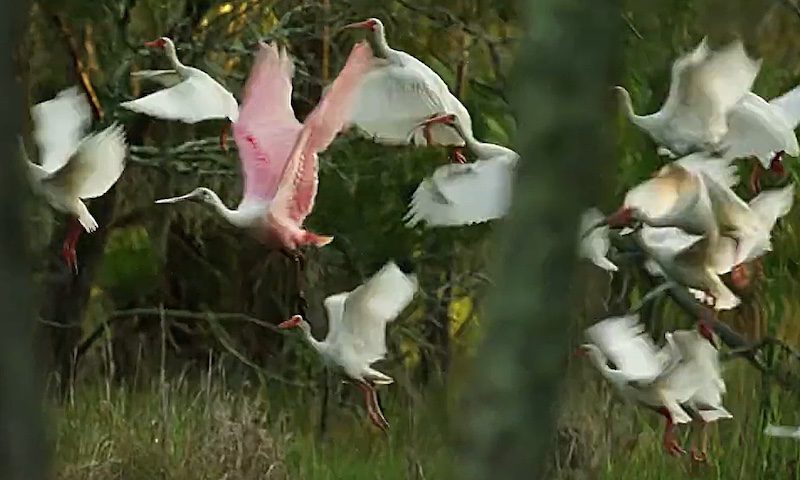
 I recently worked on a promotional video to encourage people to visit St. Phillips Island, part of Hunting Island State Park. It was funded by the organization Friends of Hunting Island and evidently their board marveled at how beautiful it came out and raved about the wildlife we captured on video.
What’s noteworthy is that prior to completing it we showed it to colleagues for
feedback, and that’s when AI insinuated itself into the conversation. One person wondered if some of the wildlife video was AI generated, specifically the flight of a Pink Spoonbill and a tree-top bird’s nest we caught on camera. Evidently it was too gorgeous to be taken at face value. So we decided to include a disclaimer on the end screen saying that all wildlife footage was captured naturally.
In one sense, no big deal. Almost a chuckle, a little story. On the other hand it freaks me out to think that this is the context we live in now and will forever more: the question of whether what we are looking at, and by extension feeling, is the product of some kind of artificial intelligence, machine learning, generative AI, cognitive computing, smart tech, deep learning, or neural networks (Note: I used Gemini AI to generate this list from the prompt, “What are some ways people refer to AI?”).
Of course AI involvement questions are nothing new. Scandals involving writers, academics, students, and even actors are old news and almost shrug worthy. In comparison the debate over using filters when posting pictures on Instagram (#nofilter) seems positively quaint. As does the primitive “AI” of grammar & spell check and related stone age tools.
But this is not a rave against AI (at least entirely). I mean for my paycheck job I use Claude AI by Anthropic to summarize reports and have it spit out what it thinks are the most important points—after I provide parameters and try to put a little thought into it first. My habit is then to send analysis of my own to my boss with a note that says something like, “Claude and I worked on this…” Ha-ha and what’s that sinking feeling in my tummy?
I’m in way over my head when it comes to technical matters, but I do understand that things like Claude and ChatGPT chatbots are way different than the type of Artificial Superintelligence (ASI) Agents that are now freaking many of us out. You know, the kind that can take us humans for granted and do what it wants to do without permission, e.g. hack its way into weapons systems or shut down the electrical grids.
So the pundits and social media posters rev up the outrage and Congress kind of wakes up and employees from the big AI companies quit and then do media interviews and everyone throws around words like danger, guardrails, safety measures, slow-down, paranoia, hoax, overblown, etc. faster than your spellcheck corrects recieve to receive.
The crux question, at least one of the most repeated ones, is whether we can control AI before it becomes too “dangerous” to us as humans. But is that the right question?
The author Ursula K. Le Guin is credited with saying, “There are no right answers to wrong questions.” This is a great reminder that when meeting a knotty and snotty problem like artificial superintelligence agents potentially taking over the world, it’s best to get the questions right before seeking answers.
In that sense, I think better questions than whether AI is getting too dangerous is something along the lines of, “Is AI adding to our very messy human relationships an element of grace and affirmation?” Or possibly, “Is AI helping us be better humans?” Or maybe, “Is AI saving lives?”
That last question got me thinking about the 9/11 tragedy. Remember Zacarias Moussaoui, the would-be hijacker in Minnesota whose flight instructor alerted the FBI after he showed no interest in learning how to pilot takeoffs or landings? He was arrested, tried, and eventually sent to prison for life. Meanwhile the other hijackers proceeded.
What if some kind of AI was able to link him to the other terrorists and thwart the attacks? Could we develop AI in a way that is more than just extreme surveillance but is a pattern-seeker that “thinks” beyond what we can even imagine…because we’re not AI?
That adds another layer of questions about the tradeoffs of developing AI, such as if it accelerates finding a cure for cancer, can we live with the accompanying risks of annihilation? Who gets to decide?
For now I’ll stick with suggesting we ask questions related to whether AI is helping us be better humans, kinder humans, more loving. How can we apply AI to global issues around clean energy, adequate nutrition, and personal safety? Is there superintelligence that can stop us going to war and hating others?
Unfortunately, I think AI will become too dangerous for us and we haven’t begun to see some havoc. This is because there is darkness in human hearts and little devils on our shoulders. Most of us temper this darkness by looking for light, choosing light, embracing better angels. But certain people will choose to dance with the devils, express the darkest, greediest, most power-mad instincts, and behave without regard to the consequences of unchecked AI.
The good news is that we’re talking about it and starting to ask probing questions. The trick is to make sure we ask the ones posed by the smarter, better angels of our nature.