 The Pilgrims had no idea what they were getting into when they made their way across the Atlantic. The hardy bunch landed on Cape Cod on November 11, 1620, and eventually made their way to where Plymouth, Massachusetts is located today. Just in time for a good old New England winter. It is no wonder that half of the original colonists died during that first winter.
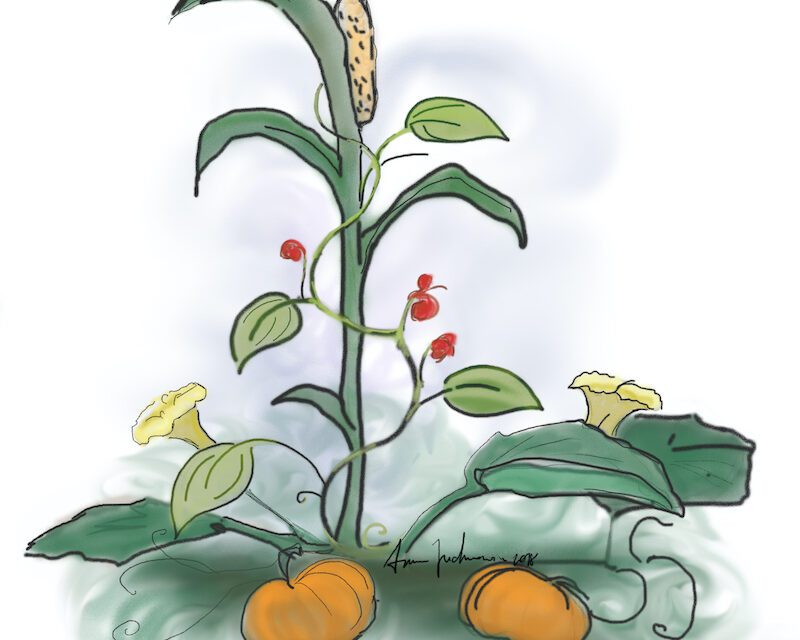
The Plymouth colony did persist against all odds, largely because of the Native Americans’ help and guidance particularly in the planting of crops. Native people of both North and South America had developed a planting method known to them as the “Three Sisters.” This involved growing corn or maize on mounded hills for drainage. Corn as we know it, was unknown in Europe and was developed by the native peoples of the Americas. At the base of each corn stalk, beans were planted. The corn stalk would act as a climbing pole for the beans and the beans added nitrogen into the soil. Most legumes or members of the pea or bean family are beneficial for soil replenishment. Squash such as pumpkin were also grown on the soil mound. All three of these food products are valuable for essential amino acids as well as protein and vitamins.
Just as the pilgrims did, we can learn a lot from Native Americans about planting and harvesting. Using legumes as a nitrogen fixing crop is still practiced today by our farmers. If you look at how corn is planted, it is usually planted in raised furrows which benefits drainage and in the northern states warms the soil sooner in the spring. The wide leaves of the squash help to shade the soil when it does get hot and keeps the soil moist. Most interestingly, many native tribes did not till the soil. We are just finding out today that the “no dig” method of growing crops and flowers keeps the soil structure intact and promotes sustainability. No dig is the now the hot up and coming method of growing things according to advances in soil science. It is interesting to note that today’s hot trend was used over 400 years ago.
Back to the Pilgrims. The Jamestown Colony in Virginia predated the Pilgrim settlement by several years. Why do we not hear as much about Jamestown as we do about the Pilgrims? Our Thanksgiving tables seem to have little Pilgrim statues or Pilgrim shaped candles on them, but not the rather rough and tumble first settlers of Virginia. The reason is that most writers of history textbooks early in our history were from New England. The Mayflower, John Brewster, and Miles Standish seem to get “press” more than any Jamestown settlers. The Pilgrim story of the first Thanksgiving has been romanticized to a point way out of its true historical significance. It seems that everyone wants to claim to be a Mayflower Descendent and indeed there are many. After that first disastrous winter, the Pilgrims proved to be a hardy bunch and now as many as 35 million people trace their ancestry to the Mayflower passengers.
What can we learn from those early settlers? They were certainly ill equipped to deal with a new land and new soil. They did bring with them seeds to plant of wheat, barley, oats, and peas. None of these crops are indigenous to the Americas
The main crop grown was what was known as Indian corn because it was easier to grow than English grains. This corn was not like our sweet corn that we steam and eat with butter. It was multi-colored and ground into corn meal that was either boiled into porridge or baked into bread. A local New England tribe, the Wampanoag, showed the colonists how to plant the corn in mounds. They dug holes for the corn seeds and placed fish in the hole to fertilize the corn and give it a good head start. Farmers and gardeners still use fish meal as a fertilizer today. Stinky, but effective in a time where commercial fertilizers were unknown.
What was eaten at that first Thanksgiving in 1621? There was more meat and fish than we would have today. Venison, wildfowl, eels, lobster, mussels, and fish were consumed. Corn, beans, and squash were served along with vegetables grown from seeds that the colonists brought with them from England such as cabbage and carrots. What you would not find were potatoes as they had not been introduced in North America yet. No sweet potatoes as the tubers had not yet been brought up from the Caribbean. No gravy because there were no mills to produce flour. And no cranberry sauce. Although cranberries are native to North America, sugar was a very expensive commodity that had to be imported from England at that time. I do believe that most of us prefer our modern day feast with a little football to follow!