
Caterpillars on parsley
Herbs have all sorts of symbolic significance in past cultures. And I thought that they just tasted good and added flavor to foods. In Shakespeare’s Hamlet, the ill-fated Ophelia uses herbs to express her feelings. “There’s rosemary, that’s for remembrance…” she opines upon remembering her father and his death. I am not morbid about rosemary and I am certainly happy that it grows so well and is perennial in the Lowcountry. It is one plant that everyone should have in their garden. Rosemary (now known as the Latin binomial Salvia rosmarinus) is green all year long and can grow into a small shrub in warm climates. I use the pine needle like leaves in stews, sauces, and on grilled meat and fish. It can even get tiny bright blue flowers if I do not snip it too much. Rosemary will grow in poor soil and take drought. It does like alkaline soil so if yours is looking a little worse for wear, give it some lime and it will perk back up. It also does not mind a serious pruning every once in a while which is not problem if you cook with it as much as I do. It dries and stores very well. I take bags of it to friends when I visit up north. Growing rosemary almost made up for the inability to grow lilacs down here – almost.
Rosemary is a perennial herb as is thyme (Thymus vulgaris). According to legend, thyme represents courage. It is a tough little plant and is often used as a ground cover and between stepping stones. I guess that makes it courageous. There are many different types of thyme such as variegated, lemon thyme, English thyme, and creeping thyme. I had creeping thyme as a ground cover and every time you stepped on it, it sent out a lovely herbal scent. Thyme is great in stews and sauces. Like most herbs, it likes full sun so plant it where it gets at least six-eight hours a day.
Bay laurel (Laurus nobilis) has traditionally been the symbol of success, honor, and victory.Beginning with the Greeks, champions and heroes were crowned with laurel wreaths. Poets and scholars could also be presented with laurel wreaths which gives us the title “Poet Laureate” and the term “Baccaleureate.” I love having a small bay laurel in a pot for its leaves. Bay leaves are used in so many types of cuisine and they are expensive to purchase. Bay Laurels can grow into small trees, but you can keep them small by pruning. They are susceptible to scale insect so keep an eye on your plant. Scale can be washed off by hand if you do find some.
Another perennial herb that I particularly love is culinary Sage (Salvia officinalis). Sadly, it is nearly impossible to grow in the ground in our climate. Sage has fuzzy soft leaves and any plant with fuzzy leaves does not like our humidity. I have grown it for a few months in a gravel garden, but it is best planted in pots and kept off the ground. In New England I had a sage bush which came in handy for Thanksgiving dishes like stuffing. If you have a sunny windowsill, you could certainly grow sage inside. In fact, most herbs can be grown inside. If you do not have a sunny spot, those indoor herb gardens with grown lights work amazingly well. As you would expect from the name, sage is a symbol of wisdom.
One perennial plant that I grow for its flowers as well as taste is chives (Allium schoenopresum).It is not really considered an herb as such, but I love the flavor of the green stalk like leaves, especially on baked potatoes. The purple flowers in the spring are a bonus. Like the herbs that I grow, I plant chives right into my garden among the flowers. They will come back every year and mine stayed upright and green all winter long. Chives are native to North America and are considered a very important pollinator plant for bees.
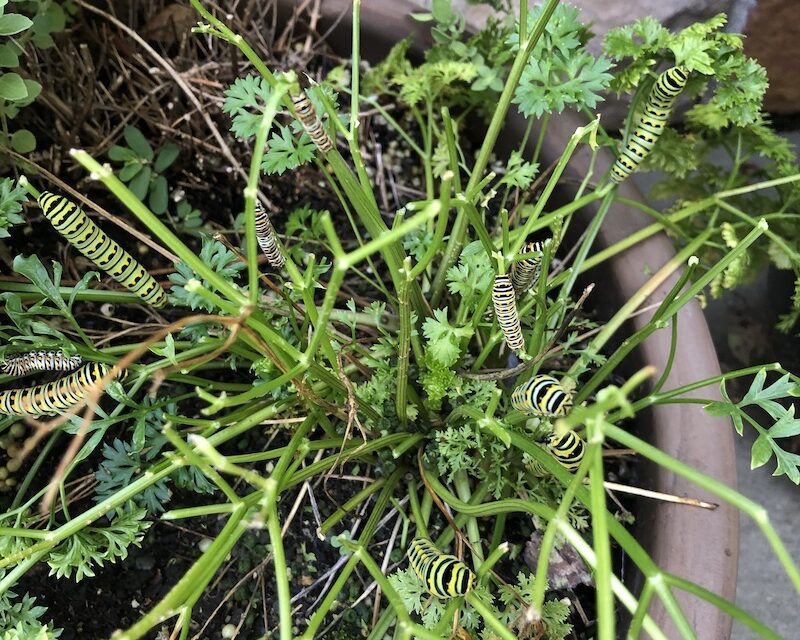
Parsley, is it an annual herb or perennial? Neither. Parsley (Petroselinum crispum) is biennial with the most usable leaves growing in the first year. I find that mine dies out in the heat, but it stays fresh and beautiful all winter long. Parsley symbolizes gratitude and not only am I grateful for this herb, but swallowtail caterpillars feast upon it in the spring. I love it as a border plant in my garden in the winter. I tend to plant it late fall and enjoy it all winter and spring until the heat gets to it.
These are some herbs that I plant right in my flower beds and not in a special herb garden. They thrive and add color and interest as well as being available for me to use in cooking. And best of all- almost all herbs are deer resistant. Those deer have no taste!