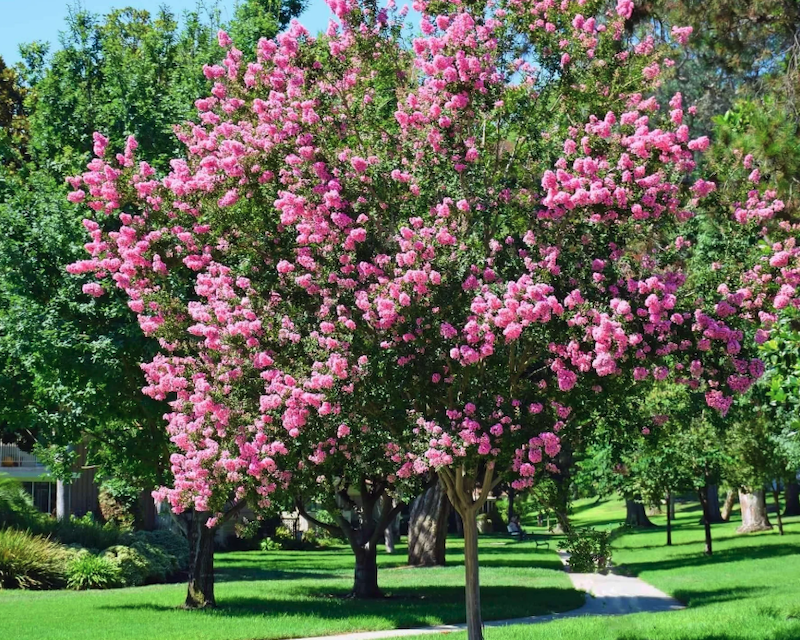
 If you read “Southern Living” magazine, you will hear the Grumpy Gardener constantly gripe, grump, grouch, and groan about the way landscapers prune Crepe Myrtles (Lagerstroemia indica). There is so much consternation about their pruning that the term “Crepe Myrtle Murder” has been attached to it. Now what are these plants that cause such a fuss? Crepe Myrtles are not native to the American South, but instead are indigenous to the India subcontinent, Southeast Asia, and northern Australia. Like Camellias, Azaleas, and Gardenias, despite their Asian origins, Crepe Myrtles have been adopted by the American South as our own special shrubs and trees.
The problem with pruning Myrtles is that landscapers often hack away at them with a chainsaw and that is not the best way to prune anything. In fact, those electric hedge trimmers and chain saws are dreadful to use to cut back any shrub or small ornamental tree. Crepe Murder is very controversial. Go online and you will find varying opinions among the experts as to if, when, and how far to prune a Myrtle. I will give you my opinion on it.
I prune my Myrtles back the end of February. I cut the tall thin branches making certain to remove any dead, damaged, or diseased material first. I use bypass pruners for a sharp clean cut (my favorite brand is Felco, made in Switzerland). I do not cut the branches back every year at the same place. When landscapers and homeowners hack their trees back every single year at the same location, the tree produces an unsightly knot. The crux is that many yards have the wrong kind of Crepe Myrtle planted. Some varieties grow as tall as 30 feet tall. This is not good if they are planted right next to your house. Rather than “murder” the tree every year, make certain that you plant a smaller variety and there are many dwarf varieties coming out each year. It is the case of is the old adage of making sure you have the “right plant” in the “right place.” Down here landscapers are notorious for planting shrubs that are too large for a foundation planting right next to the house. I had Sweet Viburnum planted right next to my house in deep shade and too close together. The result was not only that they grew into the foundation, but had a whitefly infestation because there was no airflow. They are now gone and replaced by azaleas that like the shade and do not grow too large and too fast. Bit by bit, I am rectifying mistakes made by the previous owners or their landscapers.
It does amaze me to see how people prune shrubs. As mentioned before, for the most part, power tools are not the way to go. Many “mow and blow” landscapers just chop and slash away with no regard for when the plant can and should be pruned. I visited a yard once where there was a large flat topped hedge – it was really scalped. On closer examination, they were Azaleas. Sadly, they would not bloom that year because the landscaper sheared off the buds. You should prune most flowering shrubs after they bloom and no later than July 4th. You do not wish to cut off next year’s flower buds.
You should also prune down here from the inside out, opening up the shrub to air flow. If you look closely at a massacred shrub, you will see quite a bit of dead material inside the mound of the shrub. If you let that go, you will soon have a shrub with green on the outside and brown on the inside. Ugh. Opening the shrub up also helps to prevent disease. With pruning, always cut out the dead branches first as well as any that are crossing and rubbing against each other. Look for cracked and open branches and discard those as well.
Pruning correctly can help make a beautiful healthy floral display on flowering shrubs and healthy renewed foliage on shrubs not known for their flowers such as Podocarpus, Boxwood, and Ligustrum. And it is perfectly okay to prune your Crepe Myrtle. Just do it judiciously and do not hack it down to the ground with a chain saw. That really is Crepe Myrtle Murder.