Goldenrod
Up north, as fall approaches, melancholy comes with it as flowers begin to fade away and the cold sets. In the Lowcountry while the Mosquitos may be as large as hummingbirds, one of the reasons that we are lucky to live in this area is that something is always blooming, even in the middle of winter. We have some shrubs and plants that only bloom in the late fall and it makes the end of summer a little more palatable.
Here are a few of my favorites:
I love Cassia shrubs this time of the year. This plant is also sometimes called golden shower tree. Whatever you call it, the yellow flowers cannot be beat. It does spread by volunteers so be on the look out if you do not want little trees everywhere. One other issue is that their root system is very shallow so that they tend to blow over in storms. When Hurricane Matthew hit, my Cassia blew out of the ground and down the street. This shrub is native to India and southeast Asia, but it is one non-native that brightens up the landscape. Cassia species are also host plants for the sulfur butterfly. The seed pods are pea-like and in fact, it is a member of the pea family.
Keeping with the yellow theme – Salvia madrensis or forsythia sage is a deer resistant perennial that grows about five feet tall with long drooping flowers. I have never met a salvia or sage that I didn’t like. Just place this beauty some place where it can droop – it does take up space. It is large triangular leaves start growing in the early spring, but it does not bloom until late fall. It spreads readily, but you can pull out unwanted volunteers easily. The stalks are very woody so it stands up to any autumn storms.
And how could anyone forget our wonderful native grass, Muhly grass (Muhlenbergia capillaris) or sweetgrass? Besides allowing the Gullah people to make lovely woven baskets, this grass puts on its show every October. I love the pinkish purple inflorescences, but there is also a white variety that is pretty spectacular in a grouping. I cut my muhly grass back in February, but of course, in the wild it is never cut so you can ignore it or cut it. Your choice.
Another favorite of mine is just about to burst into bloom. It grows naturally along the marsh and has spread to other undisturbed areas. I have never known anyone to plant it. It is sea myrtle (Baccharis halimifolia) or consumption weed. It has been used in the past as a medicinal plant for coughs hence it uses the old common name for tuberculosis. I like it better when the white flowers are in tight bud because they are a cream color. The flowers are very fluffy and you will notice the seeds floating through the air. You probably do not want to use it as a cut flower because you will have little wispy “balloons” floating through out your house. I made that mistake – once.
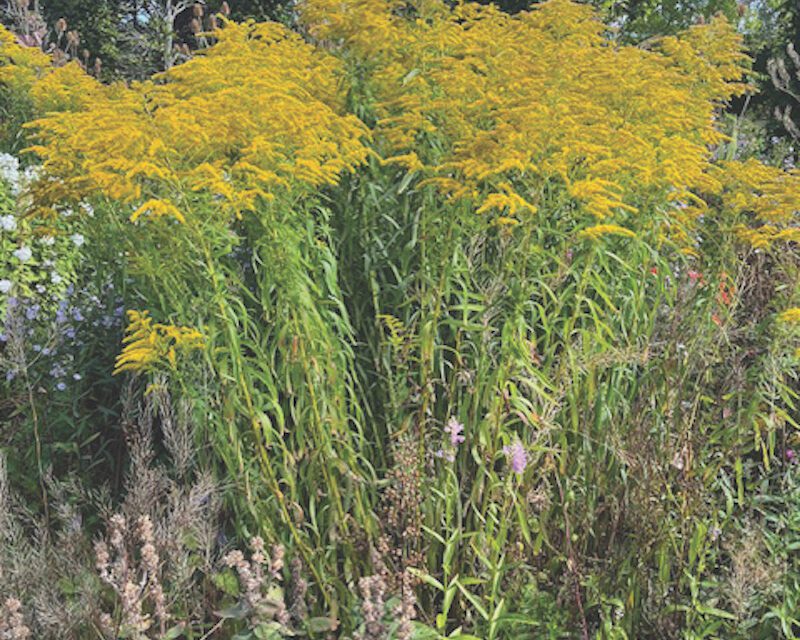
No fall would be complete without goldenrod. This plant is a native to North America and Mexico. You will find it growing in open areas such as meadows and swamplands. There are over 100 species in this botanical genus known as Solidago and it is the single most important plant species for pollinator biodiversity. Goldenrod spreads by rhizomes and seeds and can be aggressive. You will see it along roadsides in abundance. Most people consider goldenrod to be a weed. However, it has been exported to many countries of the world where is it planted in gardens for fall color. Goldenrod has gotten a bad rap in that some people think that it causes hay fever. Its pollen does not contain allergens, but ragweed which blooms at the same time does. Blame your sniffling nose on ragweed and not on our lovely goldenrod.
And lastly, a not so favorite so take this as a warning. You may have noticed an incredibly enticing scent in the air – kind of peppery like a Viburnum. The tiny flowers of this plant give off a sweet aroma, but beware, it is very invasive and can no longer be sold in South Carolina. Known as Elaeagnus there are several varieties with common names such as Russian olive and autumn olive. This vine like shrub seemingly grows over night. It has been used by landscapers as a barrier between houses because it grows fast and thickly. Although I did not plant it, I have it in my yard and I love the smell, but hate the plant. It is susceptible to scale and can really get out of hand quickly. They like it in Europe, but here, let the gardener beware.
So enjoy the cooler fall temperatures and on your walk look for some of these autumn bloomers