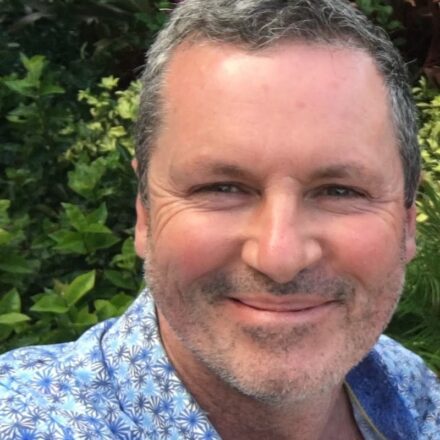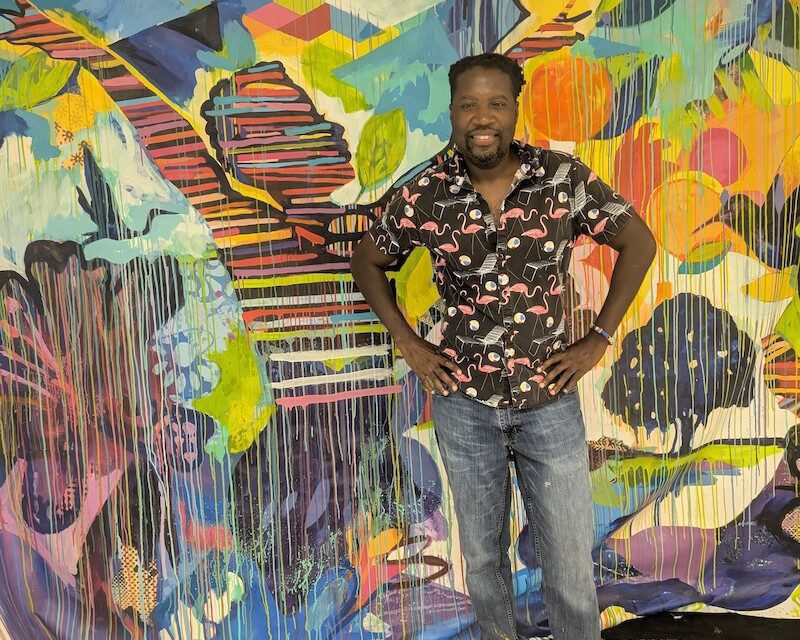
Amiri Farris in his TCL studio
When you walk into Amiri Farris’ studio a floor below the Mather Museum on the campus of the Technical College of the Lowcountry, you might want to look for the nearest handhold. There is so much art energy bouncing around the room it seems to ripple and ricochet from the walls to the floor to the corners and back. The colors vibrate, the symbols pulsate, the individual works of art, in whatever stage of completion, scream for attention. It’s enough to knock you a bit off kilter, in that delightful way an ocean wave tumbles you ashore. You know you’ve arrived somewhere, even if it’s going to take a minute to get your bearings.
In the middle of the eye of this creative storm stands mild mannered Amiri, resplendent in a Pink Flamingo shirt and slightly paint splattered jeans. He speaks gently, taking care to choose his words, and my first impression is of being in the presence of a fully integrated human person, a la this guy really has his sh*t together. Two days later this will only be reinforced when I see him in action at the Port Royal Sound Foundation Maritime Center, giving a crisp and engaging gallery talk to adoring fans (dare I say groupies?). If you’re familiar with the psychological concept of flow, characterized by deep absorption, complete focus, and loss of self-consciousness, then you’ll understand the kind of vibe I’m describing. He’s all-the-way-Amiri and from that centeredness springs forth a contemporary multidisciplinary artist infusing rich meaning in whatever he touches, paints, collages, tapes, drips, and layers. Amiri offers this.
Love is at the core of everything I create. It’s the force that binds the layers, the intention behind each brushstroke or mark-making, and the energy that flows through the paint, the textures, the colors… love guides the process.
Another part of Amiri’s process includes a cardboard box that sits in the middle of his studio that could
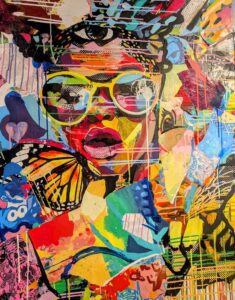
‘Meta Radiance’ by Amiri Farris
understandably be mistaken for a trash receptacle. Instead, it’s filled with paper scraps from comic books, found objects, abandoned project pieces and who knows what else. It functions as a source of inspired applications to work in progress as Amiri flows through his decidedly non-linear art-making journey. He seems to inhabit an intuitive world of wonder, and as much as he understands what it means to be a working artist, exhibiting regularly and fulfilling the needs of his ardent collectors, he willingly skates on the edge of magical thinking and boundary pushing as he searches for the next layer of meaning.
Who cares if he can only pinpoint the length of time he’s been in this specific studio as, “I think about a year or so, maybe, like, two years…” or that sometimes he only knows a piece of art is completed because the show is literally opening. Time doesn’t necessarily resonate typically for Amiri as it might for the rest of us, he’s more fluid in his approach to the passing of days. That’s why you see a specific swirling Adinkra symbol on many canvases, which Amiri explains is an indicator/reminder that what is important is to learn from your past while moving forward. Combining this notion with the force of love that underpins his creations yields work like Meta Radiance, a mixed media (acrylic, spray paint, comic books, ink, collage, found objects) portrait that was inspired by a historic photograph of a young girl at a Mather School event more than 50 years ago.
To me, Meta Radiance reads as the birth and declarative burst of a time traveler arriving in a world that is not ready for her powerful message but, hey, that’s just too bad. She’s here, she’s transformed, she’s got a third eye, get over it. Amiri writes:
The monarch butterfly near her heart signifies metamorphosis, echoing the legacy of learning, resilience, and cultural pride rooted in the Mather School’s mission.
And just like that he collapses the past, present, and future in a 36 X 48” canvas that dazzles with its beauty and demands closer inspection. Note both the vertical and horizontal drips of paint, another way Amiri indicates the passing of time on the canvas itself. But for all the pleasing elements surrounding the girl’s face, including comic book art, patchy brush strokes, several eyes, and an observer taking in the girl’s arrival and labeling it “kool,” it’s still the face that commands the scene. Her mouth is slightly open, but this doesn’t seem to decrease her confident presence one bit. Like Amiri himself, the girl seems comfortable with who she is and who she might become, taking it all in and giving it back too.
What I saw Amiri Farris giving back to the assembled at the Maritime Center was grace and positive regard. He spoke for about 12 minutes and took us around the small gallery of paintings that included canvases filled with dolphins, sharks, turtles and other Lowcountry emblems, but it was in his comments about what else his work was about that his creative spectrum unfolded.
In a mixed media piece roughly 5 X 5 feet titled The Natural Sea Island Dance you see birds (within birds), water, sun & sky, and plenty of bright flora. Things start getting deeper with a distant scene of historical flavor, suggestive of sea island heritage with two figures, a church and an old building. From the center a dancing figure of Gullah rhythm and an Andinkra symbol emerge from a background suggestive of a more modern context. Amiri explains:

‘The Natural Sea Island Dance’ by Amiri Farris
Also in this work you can see, since we’re so I would say inspired, but really almost bombarded, by technology, you can see kind of what I call the metaverse in the background. You can see digital elements even though we’re surrounded by nature and beautiful environments, we’re also intertwined with technology.
Another example then, of Amiri’s rejection of the tyranny of linear time. Gazing at this piece there is a feel of long ago and far away, but right next door and so today. We are offered a chance to respond to intermingling shockwaves from a future seemingly vaulting over us from the distant past. Every age has its dancers, and all tides will rise and fall. But it takes an artist like Amiri to layer it together in such a powerful way.
I decided to ask Jody Hayward, Executive Director of the Port Royal Sound Foundation, about why they sponsor art shows at the science and history driven Maritime Center. She said it was all about reaching the broadest audience, beyond avid boaters or fishing types.
We recognize [many people] love the art that is inspired by the Port Royal Sound. They love the vistas and photography and paintings and just the creativity that it inspires…we’re just trying to connect with each person where they are and how they appreciate where they live or where they’re visiting, and so Amiri’s artwork just beautifully represents the Port Royal Sound.
Many visitors on this day mentioned Amiri’s use of bright colors and expressive energy as the reason they love his art. Lisa Clancy from Beaufort went a bit further into the action of the work.
Amiri takes something that’s very, you know common to us that we see, but he just brings out movement and color and light.
And that might just be the universal in all his work: Amiri transforms and elevates the ordinary by virtue of layering dimensions of meaning on every canvas or wall (in the case of his many public murals). It’s like the concept of Vuja de, where we encounter the familiar but perceive it as altogether new and fresh.
In his 2024 1st edition Analogous Art Zine glossy fold-out, Amiri states simply that “Art is Everything,” and provides the ways and means for readers to be artistic themselves. He does this from a place of affirmation and belief in the authority of art.
Of all the ways to tumble in this world of excess foolishness, being overwhelmed by Amiri Farris’ call for creative participation is a sweet invitation. He desires to carry us along with him and help us create for ourselves. That is a wave worth riding in any tide.