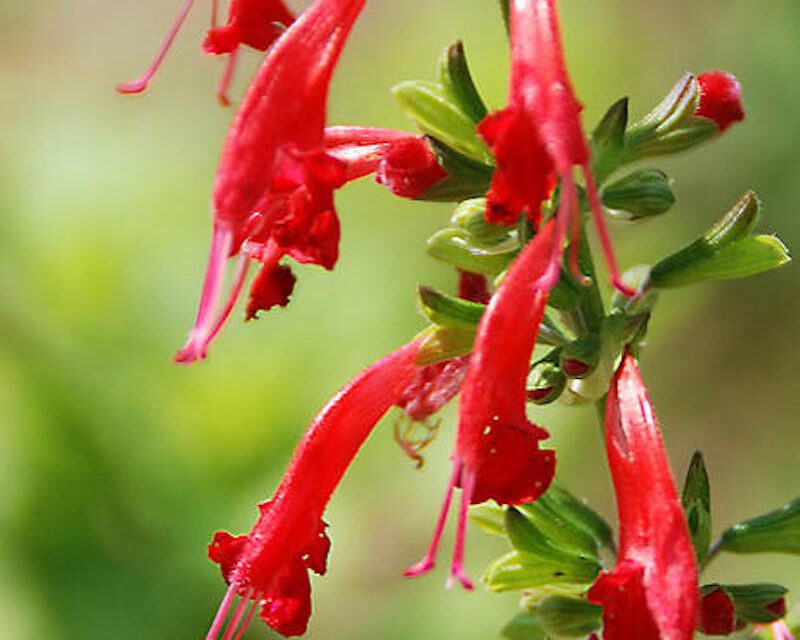
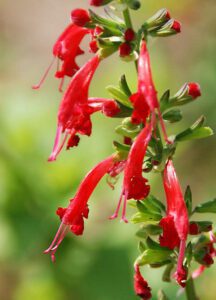
Salvia Coccinea
Insects are the most numerous animals on earth. Most are harmless and many are beneficial as pollinators and food for other animals. Only 3% are pests, but even those can be eaten. Many birds and invertebrates like dragonflies eat mosquitoes, for example.
Some easy things we can do as gardeners to encourage wildlife on our property are avoid pesticides, leave leaf litter, provide a water source, and use at least 75% native and/or host plant material. Native trees, shrubs, forbs, and grasses offer not only environmental services like nesting, cover and food but are also beautiful additions to our landscaping.
In the food web, insects are an important source of fats and protein for many other animals.
Most birds feed soft bodied caterpillars to their young. Caterpillars are eating machines. Many are specialists. Adults often lay eggs on specific host plants, so that no time is wasted growing the next generation. Once an insect egg hatches the insect larva or caterpillar needs to feed itself.
In the world of insects, the most abundant and some of the earliest to arrive were beetles. They evolved early so many of them are attracted not to nectar but pollen. Magnolias are an ancient genus that appeared before bees and wasps, they have abundant pollen but no nectar.
Bees came along a couple of million years later, but like beetles have a lot of diversity in size, food preferences, and habitat. Bees feed pollen to their young and many of the solitary bees lay their eggs on a ball of pollen which is consumed by the larvae before emerging as adults.
Flies are also pollinators but are attracted to flowers that may not smell that good to us.
Wasps are attracted to the nectar of flowers and use plant material to make paper nests. Wasps feed their young live insects.
Butterflies and moths are the most recognized pollinating insects. They are fascinating to watch and are often specific about their host plants and sensitive to environmental conditions.
Bats provide important ecosystem services such as insectivores and pollination. They consume lots of mosquitoes and other nocturnal insects.
One of their favorite roosts is in the lower fronds on palmettos.
These are a few of the important families of host plants.
- Parsley family- dill, fennel, parsley
( Swallowtails) - Pea family -cassia, legumes (skippers, sulfurs)
- Citrus (Giant Swallowtail)
- Passion vine (Fritillaries)
- Milkweed (Monarch)
Some of the plants may not be native to North America. If they aren’t invasive species, using them in a kitchen garden or orchard is a win/win for the pollinators and your family.
When you see an unfamiliar butterfly or moth one of the ways to identify it is to look up the host plant. This is where females lay their eggs, or they may be getting pollen or nectar for energy.
We cannot talk about host plants for pollinators without discussing oaks. The genus Quercus is host to over 500 species of insects that feed on their leaves. Fortunately, we are blessed with many species of oaks in the Lowcountry. Not every yard is large enough for a live oak, but others are just as important. The Swamp Chestnut Oak is one of the white oaks and is also called “basket oak” because its wood was split to make utility baskets. Other common oaks found in the lowcountry are red oak, post oak, cherrybark oak, laurel oak and water oak.
Pollen is produced on the male part of a flower. It is rich in fats and proteins, a perfect food for growing baby insects. Plants have developed many strategies to attract pollinators to visit, and in return the animal moves pollen from one flower or plant to aid in fertilization. Some animals are just looking for a sweet drink and accidentally pick up pollen grains from the flower. Others like bees and beetles are harvesting pollen to feed their young.
It takes a lot of energy for a plant to produce these resources: pollen, nectar, and seeds. It is necessary for the next generation of plants and animals.
Let’s look at a couple of our favorite families of perennials for pollinators.
Asters are composite flowers. They have fertile flowers containing pollen, nectar, and sexual parts. Surrounding the fertile flowers are sterile or ray flowers. These are often showy and colorful guides attracting insects and advertising the goods. Some common examples of this family are Yarrow which has small clusters of flower heads, coneflowers, blazing star, and Gaillardia or Indian blanket flower.
The Honeysuckle family has tubular flowers which are attractive to lots of flying insects. Some examples are our state flower, Carolina jessamine, and coral honeysuckle. Birds also can be pollinators. Hummingbirds are the most obvious. To attract them, provide tubular flowers.
The Mint family has square stems, opposite leaves and small tubular flowers. Examples are all the culinary mints as well as Salvias, basil, and oregano.
Even though we think of the Milkweed family as the larval food source for Monarchs, they are also important nectar plants for many other insects.
The Bean or Legume Family includes Redbud, found in understory woods and landscapes from Canada to Texas. It provides not only nectar but is also host to many species of insects. A favorite of the leafcutter bee; she lines her nest with little discs cut from the leaves.
The red Coral Bean is an early spring bloomer. The leaves and fruit are poisonous, so they are not eaten by deer.
Fall cassia is worth the wait for it to bloom, covered in bright yellow flowers and blooming for several months in the fall.
Native and non-native Swamp mallow, Rose of Sharon, Swamp hibiscus, are shrubby members of the Mallow family. When you look at the stamens of hibiscus you know it has pollen.
Adropogon, Digitaria, and Agrostis as well as other members of the Grass family are important as host plants and shelter for many animals including pollinators.
And many more!!!
There are so many good sites to visit pollinator demonstration gardens:
Coastal Discovery Museum
Pinkney Island Butterfly Garden
Port Royal Sound Foundation Butterfly Garden
And your garden