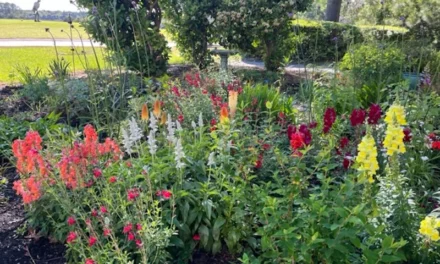
Salvias
A plant that stands up to heat, humidity, and drought, has flowers that are long lasting, and is deer resistant – What is not to like? Those plants are Salvias – one of my favorite flowers in any garden. I never grew Salvias in Massachusetts or Ohio, but I “discovered” them at garden centers down here and I was hooked.
Salvias are an amazingly diverse group of plants. There are varieties that we consider herbs suchas common rosemary (now labeled by botanists as Salvia rosmarinus ) to culinary Sage (Salvia officinalis) that we use in our dressing or stuffing at Thanksgiving. There are over 100 species and most are known for their flowers. And as scientists are extracting more plant DNA and changing plant genera, who knows how many more plants will be identified as Salvias.
You can choose between annual plants and perennials. There are annual Salvias that are quite short and only bloom for one season, but the largest number of Salvia species are perennial and many are cold hardy and can be grown from USDA zones 4a to 11. These perennial Salvias can be found on nearly every continent, but most are indigenous from across Europe into Asia and in Central and South America. They can vary in height from one to three or four feet and come in a variety of colors. They are a member of the mint family and that seems to make them fairly deer resistant. I have known some people who have had Salvia browsed by deer, but I have not had that experience and I tend a garden that is in “Bambi Land.” Most have rough leaves with a strong smell and that seems to deter our four hooved munchers.
What is the best way to plant and tend Salvias? I find that the woodier the Salvia is, the more it is able to thrive in our heat and humidity. They may start to look a little tired by the middle of August, but I cut them back and they respond with new foliage when the weather cools down.They will die back in the winter if we get some frosts, but they bounce right back in the early spring and are blooming by April. Deadheading will keep them blooming longer. They like well-drained soil and winter damp can affect them negatively. I make certain not to plant mine in low spots where water might collect. Plenty of sun and good airflow also are crucial for Salviasurvival. I nourish mine with mushroom compost in the spring for better growth. Other than that, they are generally easy to care for and I have never seen pests or diseases on my plants.
What are some varieties to consider? The only variety of Salvia that I have not had luck with is Salvia nemorosa which is a shorter and very floriferous type of plant. They just do not hold up to our humidity in the same way that other varieties do. The Rockin’ series grow extremely well. I particularly love “Rockin the Blue Suede Shoes” and “Rockin Purple.” Who names these things?Salvia “Sally Fun” is a white variety that blooms vigorously all summer long. A long time favorite is Salvia “Black and Blue” which has dark blue blossoms that age to a brighter blue. “ Mystic Spires” is another blue Salvia that I have in my garden. There are many varieties of red Salvias as well including one called “Hot Lips” which has red and white flowers like little teeth and lips. With so many species to choose from, you cannot go wrong.
An extra bonus is that pollinators seem to love Salvias and their open petals make it easy for bees and butterflies to access for nectar. Hummingbirds particularly like the tube-like blossoms.
Fall is a great time to plant perennials and shrubs. If you see Salvias at a nursery in the fall, buy them and plant them then. Most Salvias appear in garden centers in the spring, usually April or early May and that is a good time to plant as well. Whether in the ground or planted in a container, Salvias certainly give you a lot to like even if you purchase only one plant. I find it hard to resist buying several and any new varieties that appear on the scene from plant breeders.